
What emotional intelligence means across cultures
And the real consequence of a narrow, individualistic definition

This essay is not at all what I had originally planned it to be last week.
If you read part one of this month’s series (below), you know we talked about emotional hypervigilance: the nervous system response that develops when you grow up in environments where you had to scan outward to stay safe, stay loved, stay connected. We talked about how that adaptation follows us — primarily women — into romantic relationships, where it gets called maturity and thoughtfulness and ease, where we become the emotional engine of our partnerships,

This essay is the follow-up I promised: what emotional intelligence actually is. (Don’t forget that next week I will offer tools for healing, and at the end of the month I will write to your partners…)
What counts as emotional intelligence when you grew up in a culture that prioritizes interdependence rather than independence?
If I’m being honest, I went down a rabbit hole (in my head and online) about what the heck emotional intelligence is and who is deciding this and how does that even translate for those of us who live between cultures?
One of the things that has always felt incomplete to me about conversations on emotional intelligence is that they often assume there is one universal definition of what emotional health looks like. Most mainstream conversations about emotional intelligence celebrate things like expressing your feelings directly, advocating for your needs, setting boundaries, prioritizing authenticity, and speaking your truth. And to be clear, I think all of those things can be emotionally intelligent behaviors.
But they are also behaviors that tend to align with more individualistic cultural values.
As a therapist who works with children of immigrants and couples, I’ve often wondered what happens when we try to apply those definitions to our communities — to people who were raised in cultures that prioritize interdependence, family, community, and relational responsibility.
Research has consistently found that culture shapes how emotions are experienced, expressed, interpreted, and valued. (I have a whole podcast episode on this.) And, in many collectivistic cultures, emotional intelligence may include a heightened awareness of context, relationships, hierarchy, family dynamics, and the impact one’s actions have on others. Emotions are not understood as something that happens solely within an individual, but as something that happens within one or a web of relationships.
And honestly, I don’t think that’s a bad thing.
Many of us were raised to think beyond ourselves. We were taught to consider our elders, our families, our communities, and the consequences of our actions. We were taught that relationships require care, responsibility, and consideration. We learned to pay attention to other people. We learned empathy. We learned how to read a room. We learned how to think about the collective, not just the individual.
The problem, then, is not that we learned those things. The problem is, instead, that many of us were also taught that understanding other people’s emotions meant becoming responsible for them. We learned that ‘reading the room’ and ‘paying attention’ and even ‘mindreading’ were essential to being in relationships and frankly, is how we can receive and gain love in return.
I think this is where so many of us — primarily women — get stuck (me included!).
In practice, many of us have not learned how to acknowledge ourselves in relationships with others. When I sit with my bicultural/multilcultural clients, I often notice something interesting. Many of them can explain their partner’s fears, insecurities, and attachment wounds. They can identify the context behind their elders’ behaviors or words. But when I ask them what they are feeling, what they need, or what they want, there is often a long pause.
And that’s because they have spent years directing the intelligence outward.
How can we understand emotional intelligence from a cross-cultural lens?
So I wanted to see what the research actually says because so much of what we see in mainstream messaging can be skewed from an individualistic lens in this country. Here’s the thing: The original research on emotional intelligence never suggested that emotionally intelligent people are responsible for everyone else’s emotions or just about prioritizing your own.
In 1995, psychologist Daniel Goleman popularized the concept of emotional intelligence (after it was coined by Peter Salovey and John Mayer) with a framework built around four core domains: self-awareness, self-management, social awareness, and relationship management.
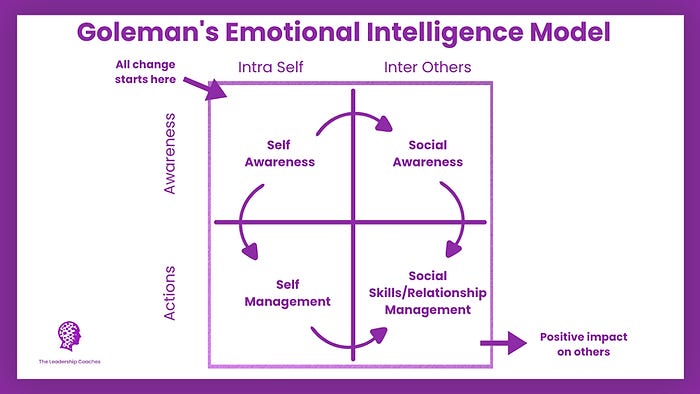
Here’s what I want you to notice about this diagram: it starts with self. Self-awareness first. Social awareness and management next. He goes on to opine that the capacity to understand and work with your own emotional experience is the foundation on which everything else is built. Goleman was explicit about this and as a therapist I whole heartedly believe in this: You cannot regulate what you cannot first recognize. You cannot be genuinely attuned to others if you have no stable, grounded access to yourself.
Let me be very clear: This does not mean you should forego the values of interdependence, filial piety, loyalty, duty, collectivism or anything else that feels important to you. But you do have to make room for yourself in your relationships. Many of us are just doing it in a different — not wrong! — order. Instead of building the foundation of self first, we have built the foundation of relationships.
Let me illustrate this because I think it’s easy to turn this into a debate about what is “right.”
Sarah grew up in a family that emphasized independence and self-expression. From a young age, she was encouraged to identify her preferences, voice her opinions, advocate for her needs, and make decisions that felt right for her. As an adult, she generally has a strong sense of who she is. She knows what she likes and dislikes. She is comfortable setting boundaries and making choices that prioritize her wellbeing. But she sometimes struggles when relationships require sacrifice, compromise, or deep consideration of how her decisions affect the people around her. She has spent years learning herself and is now learning how to be part of a collective.
Miriam grew up in a South Asian immigrant family that emphasized interdependence and relational responsibility. From a young age, she was encouraged to think about how her actions affected the family, to consider the needs of others, and to understand her role within a larger system. As an adult, she is deeply empathetic. She notices when someone is struggling. She values connection, community, and showing up for the people she loves. She has spent years learning how to be in relationship. But she sometimes struggles to identify what she wants independent of everyone else’s expectations. She feels guilt when prioritizing herself and often worries that her needs will come at someone else’s expense. She has spent years learning relationships and is now learning herself.
Neither woman is wrong. Neither woman is more emotionally intelligent. They simply started in different places.
I want to note, too, that children of immigrants are more likely to be parentified than their non-immigrant origin counterparts. Children who take on emotional caregiving roles within their families often become highly attuned to other people’s emotional states. They learn to monitor moods, anticipate reactions, mediate conflict, and care for others at a young age. From the outside, these skills can look like maturity, wisdom, empathy, and emotional intelligence. But sometimes what gets praised as emotional intelligence is actually adaptation. The child is not learning how to express their emotions. They are learning how to monitor everyone else’s. (I wrote an entire essay for you guys on parentification here)
So when Western psychology tells us to “put yourself first,” it can feel jarring because it asks us to abandon skills and values that have served us in important ways. But I don’t think the goal is to move from relationships to self. We want to move into integration, yes, but we also want to challenge that we’re morally failing if we have been prioritizing relationships before our self. There’s nothing wrong with you, and if it doesn’t feel good, we must consider how we can incrementally change the way we are showing up in these relationships. We want to learn that emotional intelligence includes understanding yourself and understanding others. Honoring your needs and honoring your relationships. Valuing autonomy and valuing connection.
Not choosing one over the other, but building the capacity to hold both.
Healthy relationships — and real emotional intelligence — require us to think about other people’s feelings. They require empathy, consideration, flexibility, and care. The healthiest relationships I see are not built on radical self-focus. They are built on mutuality.
But there is a difference between being attuned to someone and becoming responsible for them. There is a difference between empathy and self-abandonment. There is a difference between consideration and chronic accommodation. There is a difference between interdependence and overfunctioning.
This piece is an example of what paid subscribers to CE Insider receive. Moving forward some content will be paywalled to recognize the work and time that goes into researching and writing these + you can reply to this email with your questions and paid subscribers will get a video of me answering them at the end of the series!
How does trauma fit into this?
Another thing I think is important to note here: Research published in Frontiers in Psychology makes the distinction between self-surveillance and self-awareness from a neuroscience angle: trauma-induced hypervigilance and genuine emotional intelligence are actually associated with different neural adaptations. Hypervigilance is a self-preservation response — the brain scanning for threat and adjusting accordingly. Genuine emotional intelligence involves cognitive and emotional processing that is grounded and regulated, not threat-activated. They can look alike on the surface. And while parentification is not always experienced as a poor or negative thing, it has been studied as emotional neglect which is a form of childhood trauma, so it would make sense that if you were parentified you may have different neural adapations that actually lead to hyper vigilance not genuine EI.
This is the thing I most want you to understand, because I think it is the hinge on which everything else turns for so many of you.
Self-awareness — real emotional intelligence — is the ability to notice what you are feeling, name it accurately, and understand how it is influencing your thoughts and behavior. It is inward-facing. It is curious rather than corrective. It asks: what is happening inside me right now?
Self-surveillance — which is what hypervigilance produces — is the constant monitoring of your own emotional presentation in relation to how it might be received, judged, or disruptive to someone else. It is also inward-facing, but in a completely different way. It is not curious. It is controlling. It asks: how am I coming across? Is this too much? Should I soften this? Will this land badly?
The two can feel similar from the inside. Both involve paying attention to your emotions. But one is oriented toward understanding yourself and the other is oriented toward managing your impact on others. One builds self-knowledge. The other erodes it — slowly, over time, until you find yourself in the middle of a conversation you’re not even present for because you’re too busy monitoring the performance of being in it.
So what does real emotional intelligence actually feel like?
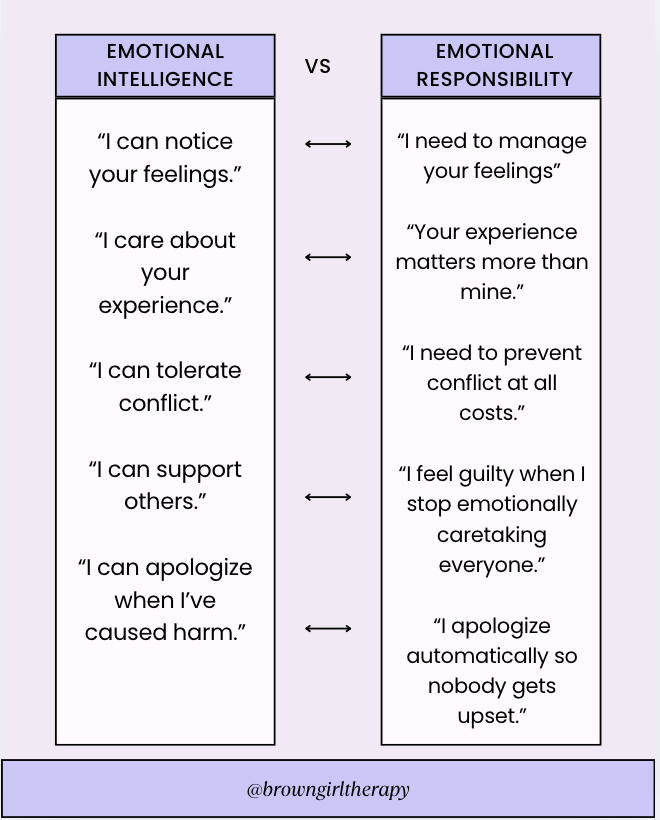
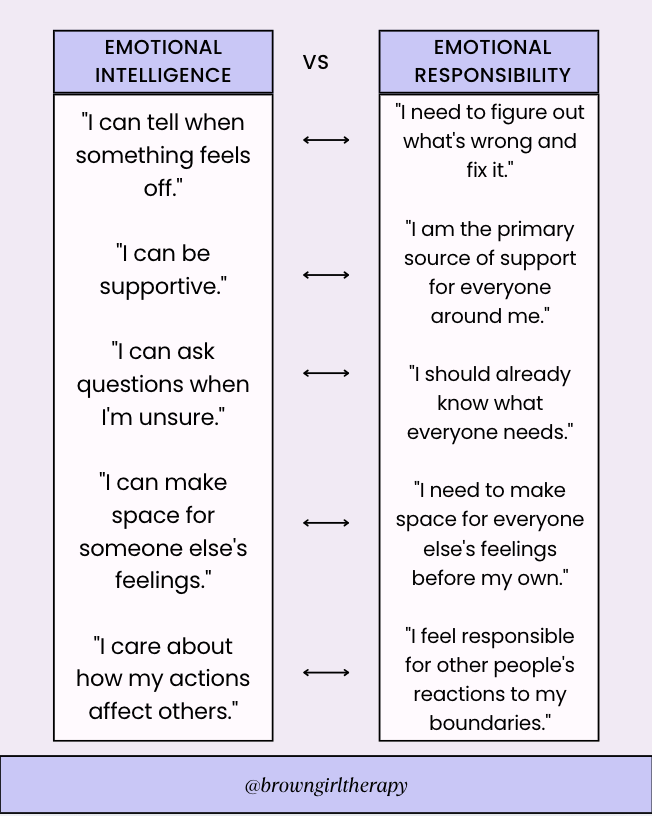
Real emotional intelligence, the grounded kind, the kind that comes from wholeness rather than fear, has a different quality to it. Here is how I have come to understand it, in myself and in the work I do with clients:
It feels like noticing rather than monitoring. You become aware of what you’re feeling with curiosity rather than alarm. You can observe your emotional state without immediately needing to manage it, suppress it, or explain it away.
It feels like having access to your own interiority even when you’re in relationship. You can be fully present with someone else and still know what you think, what you need, what you feel. You don’t have to disappear into them to be connected to them.
It feels like choosing your responses rather than just surviving the situation. Because your reactions are no longer purely threat-activated, you have a moment — sometimes just a breath — between stimulus and response. That pause is where agency lives.
It feels like being able to receive. Sitting with care rather than deflecting it. Letting someone ask how you’re doing and answering honestly. Tolerating being seen without immediately redirecting the focus.
It feels like conflict that doesn’t end you. Because you trust that you can feel hurt, express it, have it land imperfectly, and still be okay. You don’t need to prevent rupture at all costs because you’ve learned that repair is possible.
And honestly? Sometimes it feels uncomfortable as hell. Especially at first. Because the nervous system that has been oriented outward for years does not immediately know what to do with inward attention. Turning toward yourself — really turning toward yourself — can feel foreign, even threatening, in a way that is deeply counterintuitive. You’re not alone.
Next week, we’ll get into what this actually looks like in practice… what it means to stop being the emotional manager in a relationship reflection questions for you to understand if you’re self aware or self-surveilling in relationships, and how healing moves through the body, the nervous system, and the partnership itself. (Part of this essay will be paywalled.)
If you have any questions about emotional intelligence this month, reply and ask it! I’ll be posting a recorded Q&A video answering all your questions at the end of the month!
*Disclaimer: Culturally Enough. is not therapy, a mental health service, nor is it a substitute for mental health services of any kind. I am not showing up in this space as your therapist — I am showing up here as a curiosity-driven writer, peer, and a human. If you are looking for therapy, please consult with your local mental health resources.
Ways You Can Support My Work
Join my other endeavor, The Bicultural Brief, a professional digest for clinicians.
Put my name in the hat for a speaking gig at your company or org!
Forward this newsletter with someone you think would benefit from reading it.
The narrow, individualistic definition of emotional intelligence being exported globally is doing real damage. It erases relational and community-based ways of knowing — which are often the ways women in particular have always navigated emotional life. "EQ" becomes one more Western framework that flattens everything else. This piece asks the right question about who gets to decide what counts.
I recognize this essay in my marriage. The question I have is - when I am learning to be intelligent rather than responsible, this can feel destabilizing to the other party. What (and how) should I ask for in terms of support from the other party? What can I expect?